The most common mistake in compressor buying is choosing the wrong type or an oversized machine. The right decision starts with one question: how many hours a day do you actually use air?
A compressor purchase is a cost that extends far beyond the sticker price. Over a compressor’s life, the electricity it consumes usually adds up to several times its purchase price. So the question to ask isn’t “which is cheaper” — it’s “which matches how I actually use air.”
How they work
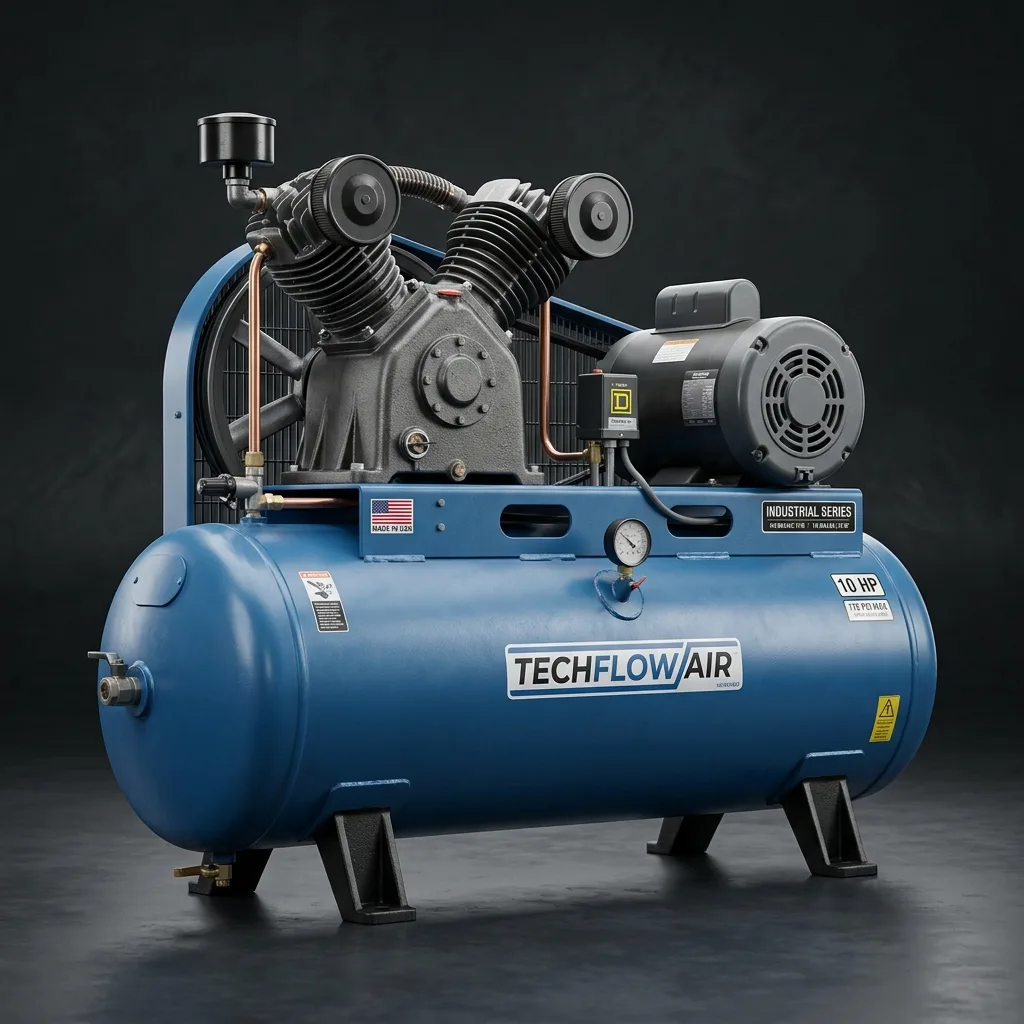
A piston compressor uses a crankshaft-driven piston and cylinder. The piston draws air in on the downstroke and compresses it on the upstroke. Simple, robust, and easy to repair.
A screw compressor compresses air continuously between two interlocking helical rotors. Rather than a pulsed output, it produces a steady flow, has fewer moving parts, and runs with far less vibration.
Side by side
| Criterion | Piston | Screw |
|---|---|---|
| Suitable duty cycle | Intermittent (~50-60%) | Continuous (100%) |
| Noise level | Higher | Noticeably lower |
| Air delivery | Pulsed | Continuous |
| Initial cost | Lower | Higher |
| Energy efficiency (continuous use) | Lower | Higher |
| Maintenance frequency | More frequent | Less frequent, scheduled |
| Typical setting | Workshop, repair shop | Production plant, factory |
When a piston compressor is the right choice
A piston compressor is still the sensible choice for businesses that use air intermittently:
- Vehicle repair and paint shops
- Small manufacturing, joinery workshops
- Tyre shops, wash stations
- Single hand-tool use
In these settings the compressor isn’t running all day; it cuts in periodically. A piston machine needs rest time, and this profile suits it. The lower upfront cost is also the deciding factor at this scale.
When a screw compressor is the right choice
If your air consumption is continuous, a screw compressor pays for itself quickly in both energy and lifespan:
- More than 4 hours of continuous air demand per day
- Multiple machines drawing air at the same time
- Production lines requiring stable pressure
- Environments where noise is a problem
Screw compressors are built to run at 100% duty. Pushing a piston machine under continuous load leads to overheating and early failure.
If your demand fluctuates through the day, a variable-speed (inverter) screw compressor is worth considering separately. By adjusting motor speed to demand, it largely eliminates the energy wasted running unloaded.
Getting the capacity right
The second half of the decision is sizing. Two mistakes are common:
- Oversizing. A machine larger than needed cycles on and off constantly, wasting energy and accelerating mechanical wear.
- Undersizing. The machine never stops, pressure drops, production slows, and the compressor’s life shortens.
Sizing correctly means totalling the air consumption (m³/min) of every pneumatic tool on site, accounting for how many run simultaneously, and matching the required working pressure. Receiver volume, pipe diameter and dryer capacity are all part of the same system.
Bottom line
Intermittent use and a limited budget point to piston; continuous use, stable pressure and low noise requirements point to screw. If you’re torn between the two, daily running hours is usually the deciding factor.
We can measure your site’s actual air demand and put comparable capacity options in front of you. A serviced, warranted used compressor can also be a budget-friendly alternative worth considering.