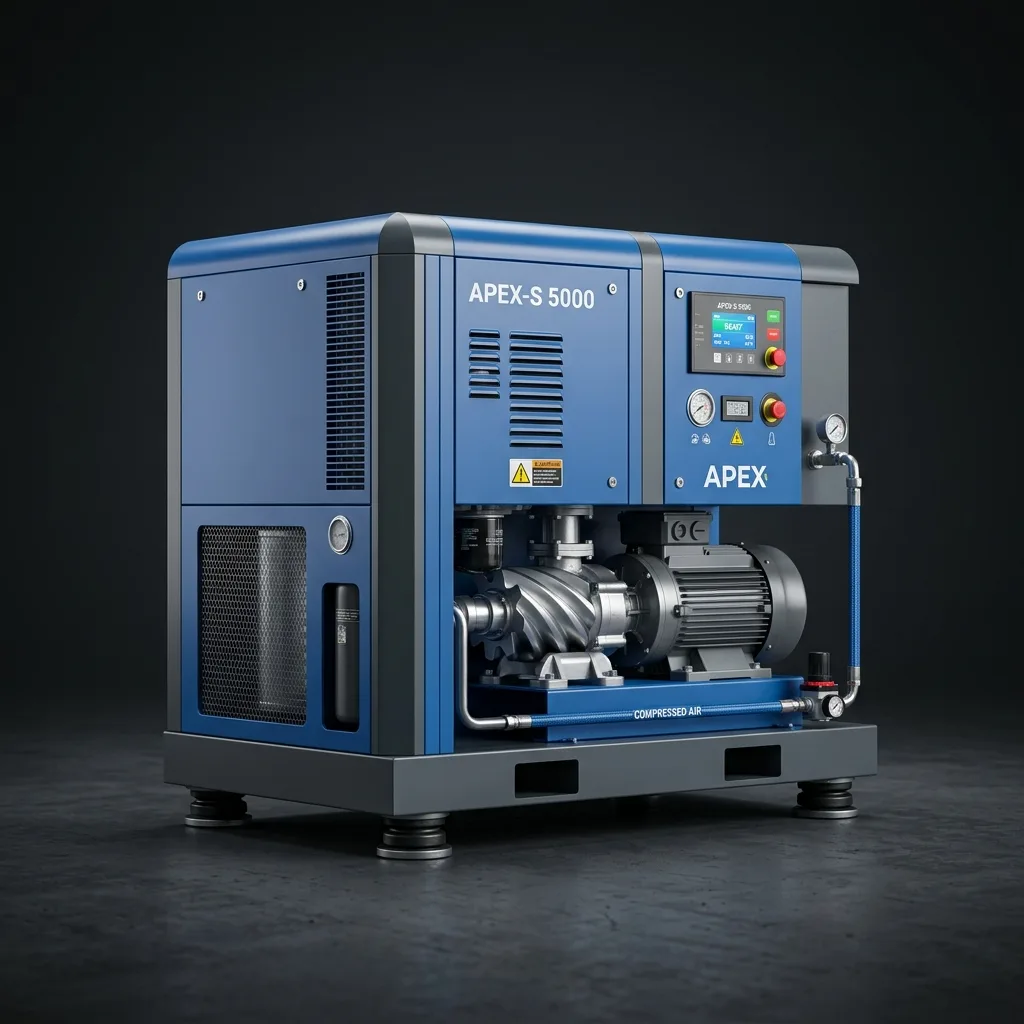
A single drop of oil in the air line can write off an entire production batch in food, pharmaceutical or electronics manufacturing. That is precisely the problem oil-free compressors solve.
Compressed air is often called the “fourth utility” in most production plants. But what counts as good air quality varies enormously by industry. In a metalworking shop, a trace of oil vapour in the line is harmless; in a pharmaceutical filling line, the same trace can mean destroying the entire product batch.
Lubricated vs. oil-free compressors
In a standard lubricated screw compressor, two rotors turn without touching, separated by a thin film of oil. That oil does three jobs: it seals the clearance, reduces friction, and carries away the heat generated during compression. It’s efficient, but it inevitably lets a small amount of oil vapour into the air produced. Filtering can reduce it, but never to zero.
Oil-free compressors have no oil at all in the compression chamber. The rotors turn without contact, machined to very tight tolerances. Oil stays confined to the gearbox and bearings, fully isolated from the air path.
What ceramic coating does
The core challenge of an oil-free design is heat. Without oil to carry it away, the compression chamber runs much hotter, and metal rotors expand. Expanding rotors either rub against each other or force the clearances to be kept wide — and wider clearances mean lower efficiency.
Ceramic-coated rotors address this directly:
- Thermal stability. Ceramic expands far less than metal under heat, so the rotors keep their designed clearance even when hot.
- Wear resistance. Ceramic is extremely hard; surface wear from any contact is much lower than with metal.
- Lower leakage. Because tight clearances can be maintained, less air leaks backward during compression, improving specific energy consumption.
Ceramic coating is not a guarantee of unlimited service life. Air-end life still depends on intake air cleanliness, ambient temperature, load/unload ratio and maintenance discipline.
Which industries actually need it
Oil-free air is not the right investment for every plant. Oil-free compressors cost noticeably more than their lubricated equivalents, and air-end overhaul is expensive. The applications where it is genuinely required typically include:
- Food and beverage production, filling lines
- Pharmaceutical and medical manufacturing
- Electronics and semiconductor assembly
- Critical stages of paint and coating work
- Certain specialised textile processes
Outside these, a lubricated compressor paired with a properly designed filter-and-dryer line delivers sufficient air quality at a far lower cost in most applications.
Questions to ask before deciding
If you’re considering a move to an oil-free system, settle these three questions before requesting quotes:
- Which ISO 8573-1 class do you actually need? The standard grades oil content into classes. “Oil-free” alone is not specific enough — put the target class in writing.
- What is the total cost of ownership? Purchase price aside, energy consumption and air-end overhaul intervals both belong in the calculation.
- Is your existing line ready? Clean air produced by an oil-free compressor loses its quality the moment it passes through a rusty, dirty pipe run.
If you’d like help deciding whether an oil-free system or a well-designed filter line is the right fit for your site, we can survey your current air demand and lay out the options side by side.