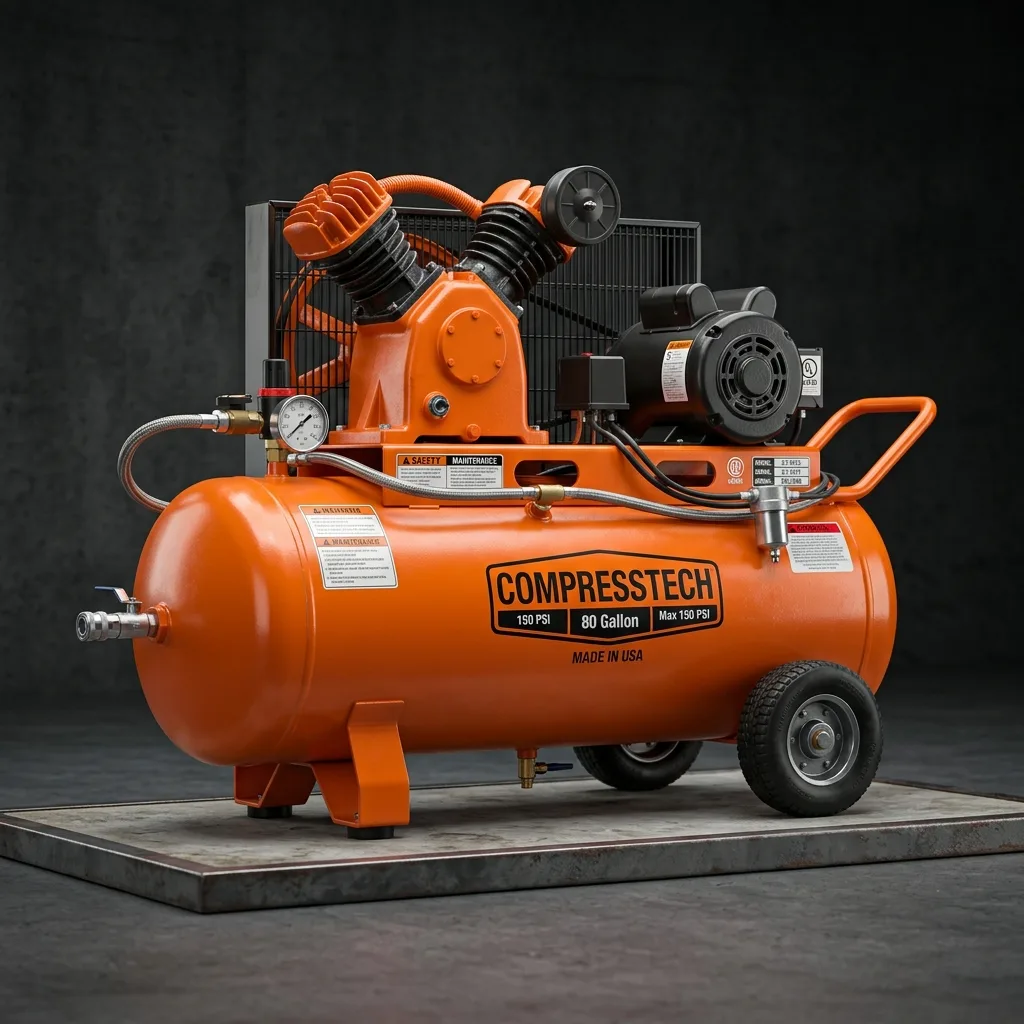
A well-chosen used compressor runs trouble-free for years at half the budget of a new machine. A badly chosen one racks up a repair bill exceeding its purchase price within the first year.
Prices in the used compressor market vary widely, and the reason is usually not how a machine looks but its history. Of two compressors of the same model and age, one may have run 40,000 trouble-free hours while the other burned out its air end at 15,000.
The eight headings below summarise the questions to ask when evaluating a machine.
1. Running hours and load profile
The number on the hour meter means little by itself. What matters is hours under load. A machine with 30,000 total hours of which 25,000 were spent idling is less worn than one that ran 20,000 hours at full load.
Modern control panels report “total running hours” and “loaded hours” separately. Always ask for both figures.
2. Air end condition
The most expensive part of a screw compressor is the air end. Check:
- Bearing noise and vibration (listen both loaded and unloaded)
- Discharge temperature — above normal can indicate internal wear
- Whether it has been overhauled before, and if so, which parts were replaced
An air end overhaul costs a substantial share of a used machine’s price at most capacities. Get in writing exactly what “overhauled” covers.
3. Oil and oil history
Oil is the compressor’s blood test. Look at:
- Colour and smell — dark, burnt-smelling oil points to a history of overheating
- Varnish or sludge in the oil reservoir
- Oil change records and the type of oil used
Mixing different oil types is a common cause of sludging and separator blockage.
4. Separator and filters
Check the separator differential pressure. A high reading means a blocked separator, which lets oil carry over into the air line. Ask when the filters were last changed; fresh filters fitted just before a sale are sometimes used to mask a missing maintenance history.
5. Electrics and control panel
- Motor bearing noise and heating
- Contactor contact condition
- Fault history in the panel — most panels store past alarms
- Cable and terminal condition
The fault log tells the story the seller doesn’t. Repeated high-temperature or overcurrent alarms are serious warnings.
6. Cooling system
Check radiator cleanliness and fan operation. A machine that ran long with a blocked radiator has prematurely aged oil and air end. On water-cooled models, check the heat exchanger for scaling.
7. Test run and warranty
Never buy a machine you haven’t seen running. Ideally, run it under load for at least half an hour and observe:
- Time to reach working pressure
- Stable temperature under load
- Clean load/unload transitions
- Leak noise and abnormal vibration
Get warranty terms in writing: duration, covered parts, and how service is provided.
8. Spare parts availability
A very old brand, or one without a service network in your country, will sit idle for weeks at its first fault even if bought cheaply. Before purchase, confirm its filters, separator and oil are easy to source.
Checklist
| Check | What to look at |
|---|---|
| Hour meter | Total and loaded hours separately |
| Air end | Noise, vibration, discharge temperature, overhaul history |
| Oil | Colour, smell, varnish, change records |
| Separator | Differential pressure |
| Electrics | Motor noise, contactor, panel fault log |
| Cooling | Radiator cleanliness, fan, heat exchanger |
| Test | At least 30 minutes under load |
| Parts | Filter, separator, oil availability |
Every used compressor we sell is overhauled, tested and delivered with a warranty. We also buy your current compressor at its real value, with trade-in available against a new or fully serviced, warranted used machine.