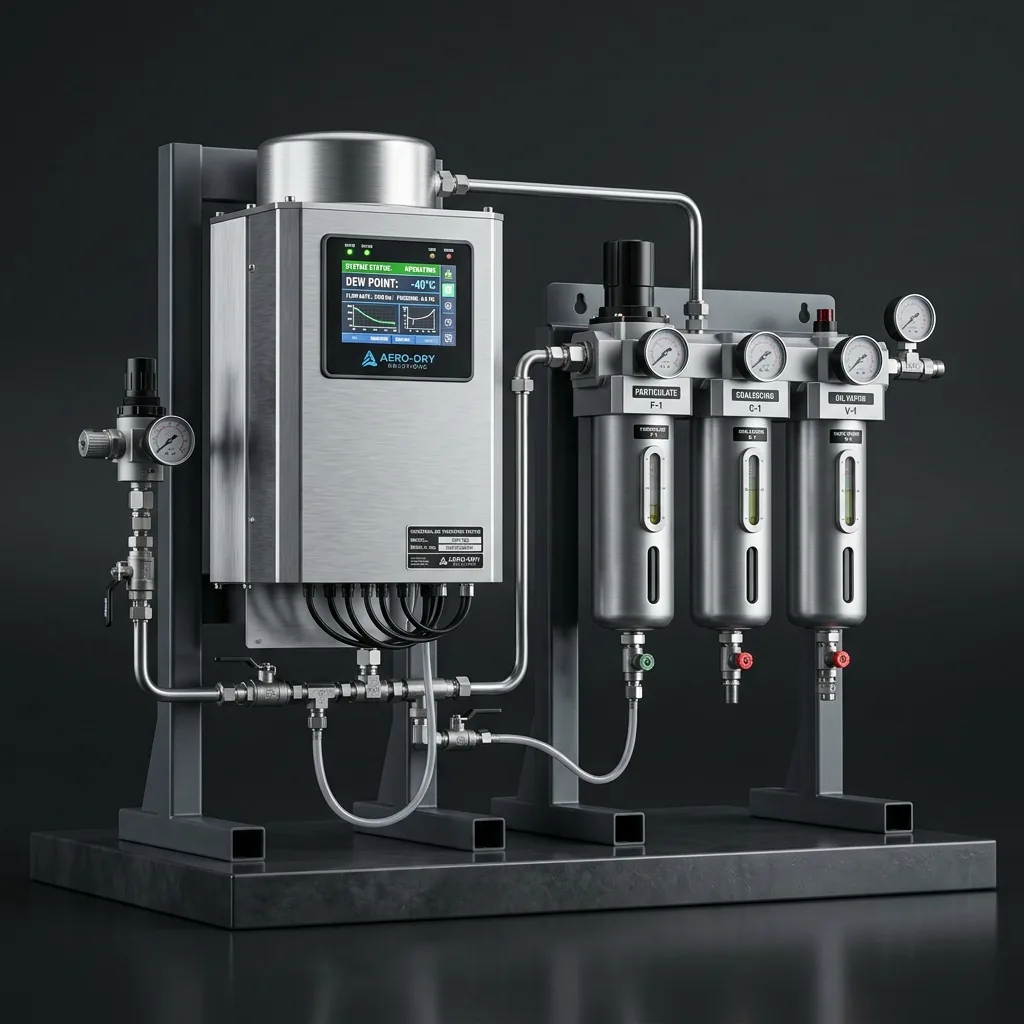
If water is coming out of your air line, that's not a fault — it's physics. The problem isn't that water forms; it's that it hasn't been removed from the system.
One of the most common complaints in any compressor room is water dripping from the end of the line. Blemishes from the paint gun, rust in pneumatic cylinders, lines freezing in winter — all of it traces back to the same source: atmospheric humidity.
Where does the water come from?
A compressor draws in atmospheric air, and that air always carries water vapour. When air is compressed, its volume shrinks but the water vapour in it stays the same — the moisture is concentrated. Compression also heats the air, and because hot air can hold more moisture, the water remains vapour at this stage.
The trouble starts with cooling. As air cools in the receiver and pipework, the amount of moisture it can carry falls, and the excess condenses to liquid. The picture looks like this:
An ordinary 22 kW compressor can produce tens of litres of condensate per day on a humid summer day. That water doesn’t vanish — it’s either drained, or it travels through your line.
The damage moisture does
- Corrosion. Rust forms in pipework and the receiver; detached rust particles clog valves and spray guns.
- Pneumatic equipment failure. Cylinders and valves lose their oil film; friction and wear increase.
- Surface defects. Craters, orange peel and adhesion problems in paint and coating work.
- Product contamination. Microbiological risk in food and pharmaceutical production.
- Freezing. Ice plugs and pressure loss in outdoor lines during winter.
Dew point: the measurement that matters
The only meaningful criterion for selecting a dryer is pressure dew point (PDP) — the temperature at which the air will begin to condense. The rule is simple: the dew point must sit below the lowest temperature the line will see.
| Dryer type | Typical dew point | Suitable use |
|---|---|---|
| Refrigerant | +3°C | In-plant lines, general workshop use |
| Desiccant | -20°C / -40°C / -70°C | Outdoor lines, sensitive production, freezing risk |
Refrigerant dryers
The most common solution. It cools the air to roughly +3°C, condensing the moisture out and draining it. It’s economical, uses little energy, and is more than sufficient for the large majority of in-plant applications.
That’s also its limit: if your line passes through an area at risk of freezing, or your process demands very low moisture, it falls short.
Desiccant dryers
These pull moisture from the air using a hygroscopic material called desiccant, reaching much lower dew points. In exchange: higher investment cost, regular desiccant replacement, and (depending on type) air consumed for regeneration.
A dryer alone isn’t enough
Effective moisture management works in stages:
- Air receiver — lets the air cool and the first condensation happen.
- Water separator / line filter — removes water already in liquid form.
- Pre-filter — captures particles, protecting the dryer.
- Air dryer — brings remaining moisture down to the target dew point.
- After-filter — catches fine particles left after the dryer.
- Condensate drains — automatic drain valves expel accumulated water from the system.
If any one stage is missing, the whole chain weakens. The most frequently skipped link is automatic condensate drainage; when manual valves are forgotten, the tank fills with water and the dryer is overwhelmed.
Sizing considerations
Dryer capacity should be selected against real operating conditions, not the compressor’s nominal flow rate. Ambient temperature, inlet air temperature and working pressure all affect capacity directly. Catalogue figures are usually stated for ideal conditions — in a hot compressor room, actual capacity drops noticeably.
We can inspect the moisture problem in your existing line on site and specify the right dryer and filter combination for your plant. We also offer repair, maintenance and trade-in options for air dryers.